
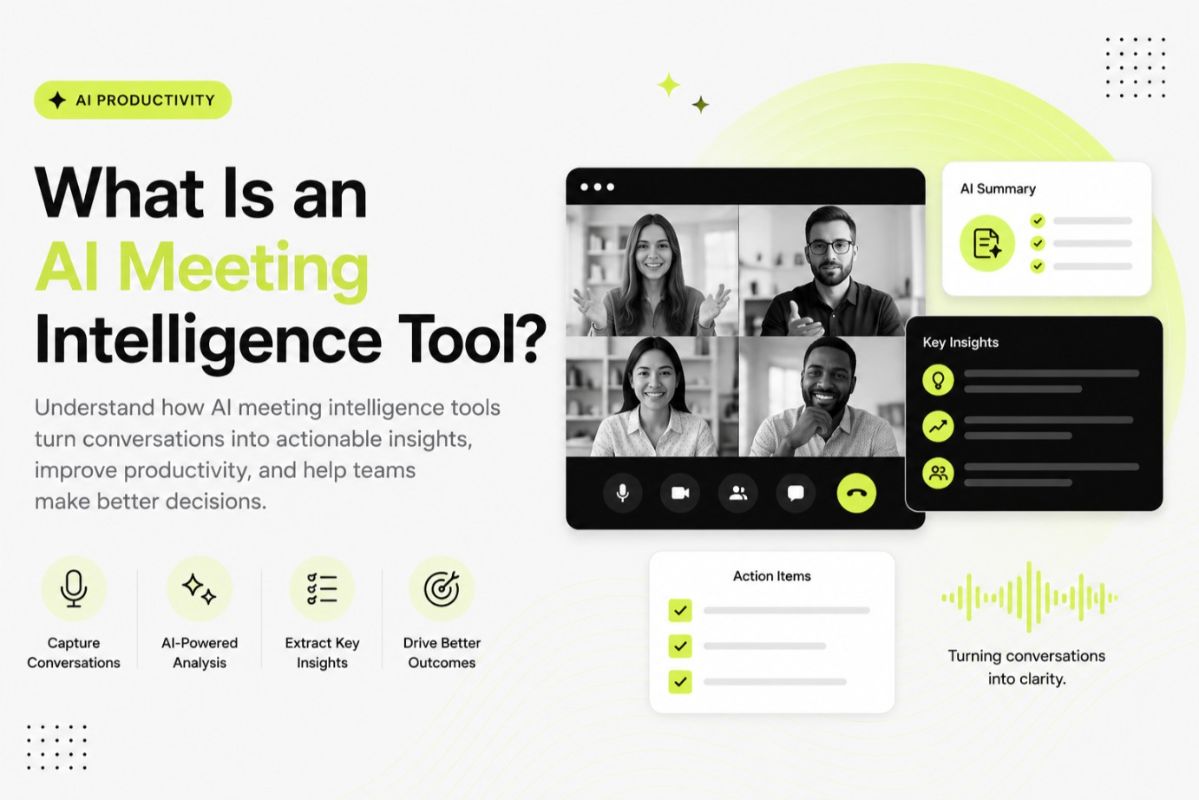
What Is an AI Meeting Intelligence Tool?
5 min read
.png)
Most AI tools tell you what happened after a meeting; Active Meeting Intelligence helps you while it’s happening. This article explores the critical shift from passive notetakers to real-time assistants like HintMint, which provide discreet, live talking points to help you handle objections and ace interviews in the moment of truth.
Think about the last time a call didn't go the way you planned.
Maybe a sales prospect threw an objection you hadn't prepared for. Maybe an interviewer asked a behavioral question, and your mind went completely blank. Or maybe you sat through a 45-minute executive strategy session and walked out not quite sure what you'd agreed to.
These aren't knowledge problems. You knew the answers, somewhere. The issue was timing. By the time your brain surfaced the right response, the moment had passed.
That's the gap AI meeting intelligence was built to close.
What Is an AI Meeting Intelligence Tool?
An AI meeting tool is software that listens to your live conversation, understands the context in real time, and surfaces relevant information, talking points, or structured responses while the meeting is still happening.
This is different from an AI notetaker. The distinction matters more than most people realize.
A standard AI notetaker, tools like Otter, Fathom, or Fireflies, works after the fact. It records the call, transcribes the audio, and hands you a summary when the meeting ends. That's genuinely useful. But it doesn't help you during the call when the pressure is actually on.
Active AI meeting intelligence works in the present tense. It hears what's being said, figures out what you need next, and delivers it to you before the moment passes, often within a few seconds.
A simple definition for featured snippet purposes:
An AI meeting intelligence tool is a real-time AI assistant that listens to live conversations and provides instant, contextual hints, suggestions, and information during the meeting, not after it ends.
The Problem With Post-Meeting Summaries
Post-meeting AI tools are valuable for documentation. They create searchable transcripts, flag action items, and reduce the admin work of following up. Organizations using them consistently report a significant reduction in time spent on manual note-taking.
But documentation doesn't fix the moment when a client says, "We're already working with someone," and you don't have a sharp response ready. It doesn't help when an interviewer asks, "Tell me about a time you led through ambiguity," and you need a structured STAR-format answer in ten seconds. It doesn't surface the Q3 growth number your VP just asked about while you're sitting across from them in a board meeting.
The summary arrives too late. The insight needed to happen live.
This is the core limitation of passive AI recording: it captures what happened, but it can't change how it went.
How Real-Time Meeting AI Actually Works
The architecture behind real-time meeting intelligence involves three things happening almost simultaneously:
1. Speech recognition for meetings
The tool captures system audio from your device, no bot joining the call, no visible intrusion. Advanced speech recognition models convert spoken words into text with low latency, typically accurate enough to distinguish between speakers and handle industry-specific vocabulary.
2. Contextual awareness
This is where AI meeting intelligence earns its name. The tool doesn't just transcribe, it interprets. It understands that a question like "what's your pricing for enterprise?" requires a specific kind of response. It recognizes when a behavioral interview question is being asked and what framework is most useful. It tracks the flow of the conversation and surfaces information relevant to where things are heading, not just where they've been.
3. Discreet hint delivery
The output appears as a private overlay, visible only to you, never to the other participants. This is what makes tools like HintMint genuinely useful rather than disruptive. You glance at your screen, see a suggested talking point or a structured response guide, and continue the conversation naturally. The other person has no idea.
Who Actually Needs This?
Three groups consistently run into the problem that active meeting AI solves.
Sales professionals
Sales calls are high-stakes conversations where timing is everything. A rep who hesitates when a pricing objection comes up looks unprepared. A rep who can instantly pivot to a value-based response keeps the deal alive.
Real-time sales call intelligence gives sales reps a live feed of useful context: objection-handling frameworks, product differentiators to mention, competitor comparisons, and reminders of what the prospect said in a previous call. It's the difference between winging it and having a well-briefed colleague whispering in your ear.
For sales teams specifically, this kind of active AI assistance has become one of the clearest ways to improve call quality without requiring reps to memorize an ever-expanding playbook.
Job seekers and career professionals
Interview preparation has always been about anticipating questions and rehearsing answers. But live interviews introduce a variable that preparation doesn't eliminate: pressure.
Real-time interview help works differently from prep tools. Instead of quizzing you before the call, it assists during it. When the interviewer asks, "Give me an example of when you influenced without authority," an AI meeting assistant with live response structuring capabilities can immediately suggest a framework, surface a relevant experience from context you've uploaded & help you stay organized under pressure.
This is AI for job interview preparation taken to its logical end, not just training before the fight, but coaching during it.
Leaders and knowledge workers in high-stakes meetings
Executive meetings move fast. Commitments get made, numbers get cited, and decisions land before anyone has had time to think carefully. AI tools that help contextual meeting awareness participants stay on top of what's being decided, what they've agreed to, and what data points are relevant to the current topic, without breaking the flow of the conversation to look things up.
HintMint: Active Meeting Intelligence Built for Real Conversations
HintMint is designed specifically for this real-time layer of meeting productivity. It runs silently in the background while you're on any video call, Zoom, Google Meet, Microsoft Teams, and provides live, contextual hints that only you can see.
The product is built for people who care about what happens during the meeting, not just what gets documented afterward.
A few things that distinguish it from passive tools:
The hints are contextual, not generic. HintMint doesn't surface boilerplate suggestions; it reads the conversation & responds to what's actually being said. If the discussion shifts from pricing to timeline concerns, the suggestions shift with it.
It works without interrupting the call. There's no bot joining as a participant. No notification to other attendees. The overlay is private and can be positioned to stay out of your visual field until you need it.
It's built for multiple use cases. Whether you're closing a deal, navigating a technical interview, or presenting to a board, the tool adapts to the nature of the conversation.
AI Notetaker vs. AI Meeting Intelligence: Clearing Up the Confusion
The market has started using "AI notetaker" and "AI meeting assistant" interchangeably, which creates real confusion when people are trying to solve different problems.
Here's the clearest way to think about it:
What you need What to use
Documentation after the meeting AI notetaker (Fireflies, Otter, Fathom)
Real-time help during the meeting , Active meeting AI (HintMint)
Both use them together; they solve different problems
Meeting transcription vs. meeting intelligence isn't an either/or question. Transcription tools are excellent for creating records, syncing to CRMs, and reviewing what was said. But they don't change how the meeting goes.
A real-time meeting assistant vs. a post-meeting summary represents two different moments in time: the moment of action versus the moment of reflection. Both have value. But if you've been using only one kind of tool and wondering why your calls still feel like missed opportunities, you've been optimizing for reflection when the problem was in the action.
How to Improve Your Meetings Starting Today
Whether or not you use any AI tool, the core discipline of meeting preparation matters more than most professionals give it credit for.
A few things that consistently improve meeting outcomes:
Know your three key points before any call starts. Most meetings get derailed not by bad information but by people who aren't sure what they are trying to accomplish. Going in with a clear sense of your top three goals creates natural coherence in your responses.
Use structure when answering behavioral questions. The STAR format (Situation, Task, Action, Result) works just because it forces clarity. Even in a sales context, structuring your stories, "here's the situation, here's what the customer needed, here's what we did, here's the outcome", makes you sound more credible.
Track commitments live. One of the most common meeting failures is that someone says, "I'll send that over by Thursday," & Thursday comes and goes. Tracking commitments as they are made, whether through a tool or a simple notebook, dramatically improves follow through.
Active meeting AI makes all three of these easier to do in real time. But the discipline matters independent of the tool.
The Bigger Picture: AI Meeting Intelligence as a Category
The category is still young. Most people are aware of AI notetakers; they've become fairly standard in modern workplaces. But real-time AI assistance during live conversations is a different problem technically and a different kind of value for users.
As of 2026, the best AI meeting assistant tools are starting to diverge clearly between the passive and active models. Passive tools have gotten very good at documentation, search, and CRM sync. Active tools are getting better at the moment of truth: what do you say next & how do you structure it?
HintMint sits firmly in the active category. It's not trying to document your meetings, it's trying to change how they go.
For anyone who has ever walked out of a call wishing they'd had sharper answers, better timing, or just a little more confidence in the moment, that's what real-time meeting intelligence is for.
About Author
Muhammad Aatif Bashir is the Founder & CEO of RTC LEAGUE, a deep-tech company delivering enterprise AI communication solutions. With a strong business and telecom leadership background, he drives the vision behind TelEcho and HintMint, enabling organizations to scale intelligent customer interactions and enhance decision-making in high-stakes, real-time environments.

.png)